Tuesday, November 30, 2021

Car Trouble

      It started last Wednesday.  I was sitting in my car at a stoplight, in one of two left-turn lanes where two major streets intersect, traffic zooming by on my right and someone with a pretty powerful car stereo thumping on my left.

      I had the local NPR station (the hub of a massive multi-station operation that covers much of the state) droning away; it's one of the few stations that still has top-of-the-hour newscasts.  I usually alternate between them and the Jazz/Classical station from the University of Indianapolis.  Suddenly, there was another visceral "thump," off the rhythm of whatever was playing in the car next to me. Odd.

      The light changed and I started my turn.  My car -- a Lexus RX350, a fourteen-year-old mini RV in decent shape -- was running rough, almost hesitating.  As I finished the turn and accelerated, I looked down at the dash instruments and there were new idiot lights lit up, "VSC" and a flashing "CHECK ENGINE" symbol.  Uh-oh.

      Work was about a mile and a half away, so I drove carefully the rest of the way there. parked and texted Tam.

     She replied in a few minutes: THE INTERNET SAYS IT'S PROBABLY A LOOSE GAS CAP.  CHECK IT.

      There's a relief!  I checked it, loosened and retightened it, and started the car.  No lights.  Whew!

      Then they came back on.  Uh-oh, again.

      Long story short, I drove home that evening with trepidation, found no good news online, and spent Monday morning finding a shop that would look at my car before the end of the week.  A lot of places don't like fiddling with Lexuses (Lexi?  Lexopodes?); the vehicles are like Toyotas except where they're not, and they're not in many ways and parts that are apparently irritating.  Tam likes an import specialists up by Castleton and I have been happy with their work -- but so are a lot of other people; they were booked up.  There's a well-regarded boat and high-end car mechanic not too far from us, the kind of place that thinks of a Lexus the way most shops think of a Chevy, but they were booked up, too.  That left the dealer, and yes, they could get the car in in a couple of days and provide a loaner for the duration.  Well, it's overdue for some depot-level looking-after anyway, so I scheduled that--

      In the scheduling, they run through the signs and symptoms. 
      Dealer:  "A what light?"
      Bobbi: "It says VSC, Victor Sierra Charlie.  And a 'Check Engine' light."
      Dealer: "And you made sure the gas cap was on tight.  H'mm, I need to check something."  Click.
      (A minute later) Dealer: "Is it flashing?  The Check Engine light, I mean."
      B: "Yes."
      D: "Do not drive the car."

      Yes, they wanted me to have it towed. 

      After more calls, I have a wrecker scheduled, a rental car for a couple of days, and a service appointment.

      The replacement dishwasher and kitchen range just got a few more months away.

      The good news: The rental is nice!  Some kind of little VW small-SUV, which turned out to have a third row of seats (small size) hiding when I moved over my bug-out bag and suchlike to the space inside the rear hatch.  The steering ratio is higher than I'm used to and the cockpit is seriously high-tech, but it has that VW characteristic of being pleasant to operate without any serious quirks.

      Next up, meeting the tow truck tomorrow.

Monday, November 29, 2021

Mentors

     I needed to bore a 7/8" hole in the top of my nightstand, so I could permanently mount the "microphone boom" that holds my Kindle so I can fall asleep reading without breaking my nose.  I've been using the clamp-mount base for years and I keep promising myself I'll make it permanent.

      Okay, down to basement workshop to find tools for the job. H'mm, it's "engineered bamboo," which is like hardwood plywood, so a Forstner bit will be unhappy. I'm not going to risk my century+ old softwood auger bits from Vonnegut Hardware, but here in the "worn-used" collection is an Irwin-type auger bit with a fine-pitch leadscrew for hardwood, and another.... I needed a 7/8" and sure enough, there was one stamped "14." I dug out a small file; couldn't find the special paddle-shaped file for auger bits. A Japanese-type "feather file" was a good substitute, and in a few minutes, I had a nice, sharp bit, ready to go.

      Upstairs, boring with brace and bit, I had to use a small block of wood on the underside of the nightstand top, so the leadscrew could pull the auger bit all the way through, and as it cleared, it struck me what an incredible debt I owe my to Dad and to two men I never met: Eric Sloane and Alfred P. Morgan.

      Mr. Morgan was a prolific writer of "How-To" books, especially for young people. His books were my introduction to electronics and to building things. Mr. Sloane was a tool collector and wrote many books. Both of them illustrated their own work and both were early aviation enthusiasts. And both of them, like my Dad, were very much interested in sharing the whys and hows of doing things. Without them, I would never have learned that old augers are marked by their size in 16ths of an inch or the difference between hardwood and softwood augers; without them, I would never have known how to sharpen a dull auger, or even how to properly bore a hole with a brace and bit.

      Thanks to them, it was a quick, simple task -- and thanks to them, I cleaned up the tools and put them away properly afterward, too.

      None of the three is still around to thank. Two of them have left us plenty of good information. Alfred P. Morgan and Eric Sloane both have extensive Wikipedia entries and many of their books are still in print or available as scans.

Sunday, November 28, 2021

Holiday Transmission

      There's a new coronavirus variant -- or at least new to the people who keep track of them.  There have been a whole lot of news and commentary items discussing it, but the takeaway at this point is that nobody knows much about it.  Oh, the folks in big labs say they are seeing a whole lot of mutations on this one, in locations that may not bode well, but how that might translate into how much trouble the blame thing is for people, no one knows.  We will find out the hard way, because that's the only way there is.

      The coronavirus appears to be getting seasonal, in an odd but predictable way: it has gotten worse during long spells of staying-indoors weather, and ebbed when people are comfortable being outdoors.  The hottest part of Summer in the South saw an increase of cases and as Fall gives way to Winter in the North, cases are ramping up.  Look, I'm not telling you how to live your life, but having your holiday party outdoors around a roaring bonfire is a safer bet right now than cramming a few dozen friends and relations across three or four generations into three small rooms for the better part of a long afternoon.  (It's also easier to toast marshmallows and make s'mores outdoors around a fire, which is my personal preferences showing.)

      Noodling around with numbers, some 59 percent of the U. S. population has been vaccinated and something between 14 and 33 percent of us have had the virus.  That would be a comforting total, if this were a simpler world--  No one is tracking the overlap between those numbers and you can play "choose your own results," trying to find out what kind of immunity last longest and offers the broadest protection against the SARS-CoV-2 virus in all its variations.  All of it helps and past that, a lot of people know a little but definitive answers are not forthcoming yet.

      Just be careful.  There is still no need to panic or scoff (TV and online pundits, I'm giving all of you well-deserved side-eye).  Be sensible in your celebrations.

Saturday, November 27, 2021

That Was Interesting

     So I went back to the main campus of the Skunk Workings yesterday afternoon and evening, helping to fill in for a vacationing co-worker.  My old desk was buried under nineteen months of trade journals, which I promptly threw away.  My spare fountain pen was still there, along with a few hastily-abandoned projects.  Most of them had been made moot by subsequent changes. (And I just realized I left one that I had intended to pick up.  Well, later.)

     One of the strangest things was walking in the formerly somewhat dingy employee entrance and finding the walls shouting at me!  There's an ongoing construction project on the second floor, with the usual mess, mud and clutter behind the building.  Perhaps in an effort to make up for it, the corridors just inside the employee entrance have been brightened up with colorful wallpaper and giant-sized encouraging slogans.  It's cheerful enough, but if you're expecting well-scuffed neutral tan walls, it's something of a shock.

     The one-way halls of the early pandemic seem to have been forgotten.  Mask-wearing is required in shared areas and people were generally diligent about it.  Water coolers and several doors have foot controls -- a simple (but clever) handle for the doors and nice dentist office type pedals for water.  The pandemic capper was when I visited the washroom, to find this sign on every other door:
DO NOT USE THIS STALL
FOR SOCIAL DISTANCING

     It's good to see the Department of Ambiguity is still on the job!

     Still pretty much the same old place,  though emptier and a little sadder these days.  I started my career in a part of my line of work which had been much larger, and facilities showed it.  I moved to a different segment of the industry, which was bustling at the time.  It appears I'll reach retirement much as I began, in the grand remains of a prior age.  Here's hoping it lasts long enough for a graceful exit.

     The changes in my workplace make writing I Work On A Starship stories a bit more of a challenge.  Increasing automation and improved equipment will tend to shrink the technical and operating crew of the USAS Lupine, too -- not as much or as quickly, of course, thanks to the sheer size of the starship and the essential nature of the geekery, but it's still inevitable.

Friday, November 26, 2021

Gotta Work

      The nature of my employment is such that we're lucky to get any holiday off.  The day after?  Nope. Oh, there are rare exceptions; corporate largesse for the day after Thanksgiving has come along once or twice, and I think we got New Year's Day once -- in the past thirty-plus years.

      Today is not one of those days off.  I do get to start my day a little later than usual.  And, for the first time since April of 2020, I'll be down at the Main Campus.  With...people.  I have not set foot inside the place for the past eighteen and a half months, so that's going to be a bit of a hurdle.  There are a lot of new faces (the Great Resignation hit us, too) and I'm not all that comfortable even around people I know. 

      To add insult to injury, there's something wrong with my car.  Day before yesterday, it suddenly started running rough and lit up a pair of warning lights that Tam tells me frequently mean the gas cap has come loose (she looked it up).  Unfortunately, mine has not.  So it needs to go into the shop, and sooner rather than later.  I may have to beg Tam to ferry me to and from today.

Thursday, November 25, 2021

I'm Thankful for Good Friends -- And For Turducken!

      I'm thankful the past few years haven't been worse, too.

      The food this year-- 

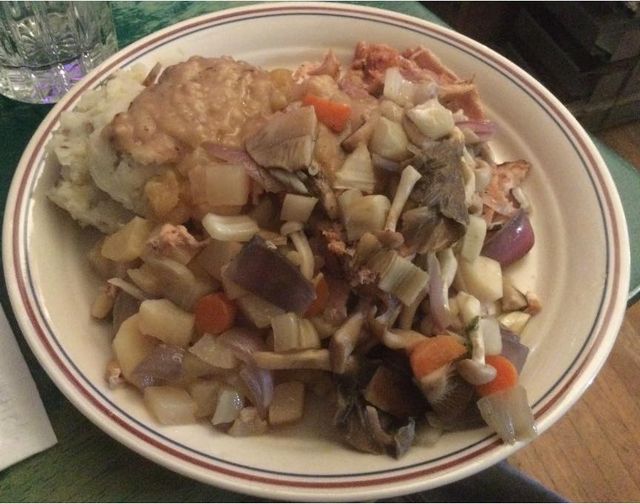
     Modesty forbids waxing too ecstatic, but this year's turducken was a good one.

     Cooked in a lidded roasting dish over hardwood charcoal, with diced turnip, apple, parsnip, a little carrot, a red onion and a fennel bulb added at about the halfway point. Several bay leaves atop the turducken, just for fun.

     On the side, fresh mashed potatoes, bacon gravy made from scratch, and mixed fancy mushrooms cooked over the charcoal in an open pot, with onion, fennel and carrot (since I had more than fit the roaster).

      This turducken was turkey, duck, chicken...and spicy cajun sausage to fill the gaps! The bacon gravy went especially well with it. Cooking it with an apple and fresh root vegetables ensures it comes out moist and flavorful.

     Details:  The turducken got two hours and forty-five minutes; turnip, apple and parsnip went in after about an hour, carrots, onion and fennel followed at the ninety-minute mark.  I use indirect heat: start the charcoal, and once it has caught, rake it into two rows, one on each side of the grill.  Put the grating in and set the oval roaster on it, centered.  I use an inexpensive meat thermometer to check, and this bird reached 190 degrees inside!  Plenty done, even for sausage. 

Wednesday, November 24, 2021

Cold Morning Before Thanksgiving

      Let's all think happy, positive, reality-based thoughts!

      For a damn change.

Tuesday, November 23, 2021

Threats? Really?

      Tsk, tsk.  So 1938. Or perhaps so "guilty by reason of wearing eyeglasses." Same, same; brute nitwits try to outvote math with fists. Not how that works, here in civilization, and you haven't managed to push that over.

Monday, November 22, 2021

Oh, I Get Letters

      But the letters don't have cites, or, in one case, they have half-arsed cites to derivative data.  So they'll get refuted but not published.  This may lose me some "near-fans."  I don't care.  This blog is a hobby, not a business, and the reward is getting up every morning and doing some writing instead of laying in bed, staring blankly at the Stupid Human Tricks in the morning TV news.  That people may (or may not) read what I write afterward is a fringe benefit for me and a lagniappe for them; it's not the point of the exercise.

     A commenter with a predilection for using ALL CAPS for emphasis* wants to know if I am a "genetic virologist."  Since no such specialty appears to exist, I couldn't be one.  What I am, is a techie and a writer.  I have been on what we used to call The World Wide Web since text-based interfaces, "Lynx" (and others) for the Web,  "Pine" and "Elm" for e-mail, "tin" and "trn" for Newsreaders, back when e-mail and Usenet News were much more interesting parts of the Internet than that dorky web-thing and we searched with Archie, Gopher and a few others.  I remember Inktomi and AltaVista, which came along shortly after I got a computer that had a color display and that looked at the Web with a "browser."  I was pretty good at telling BS from real data, and at times hung around with some of the smart-alec Netizens who liked to confuse the newbs.  (That was real fun, back before the Eternal September washed it all away in a flood of cluelessness.)  My work just happens to call for extreme reliability from the critical widgetry -- as I have mentioned recently, 99.9% uptime would be considered a dire failure.  So I am interested in things like reliability and large numbers.  I was the last of the slide-rule generation in High School and gave up scientific notation and three-significant-digit accuracy in college with great reluctance and (on the part of both me and my professors) ungraciously.  Plus, I like reading what might be called "geek history," histories of science, technology, medicine...epidemics.  And I read obsessively.

     So I have been around.  I know bullshit when I encounter it.  Large numbers don't impress me.  I have some idea of the technological path the human race has taken to get where we are today.  No "genetic virology" required.

     With that out of the way, I'm going to do some link-heavy 'splainin'.  The links are to sources I believe to be relatively unbiased.  None of them are to commentary-heavy sites, either Left or Right.  As much as I am able to do so, they are to factual data and solid sources.  Or at least they link to good sources themselves.

     Let's dig in.  The chickenshit† propagandists of vaccine hesitancy‡ are very fond of using VAERS, the Vaccine Adverse Event Reporting System, a joint data-gathering venture of CDC and FDA.  They take reports, and present the raw data; as I write, over 195 million Americans are fully vaccinated, just over 59% of us.  It's a huge pool and some of them were going to die, for a huge number of reasons, with or without the vaccine.  (Excess mortality graphs comparing year-to-year or year-to-average are useful for understanding this.)  Or as they tell us, "When evaluating data from VAERS, it is important to note that for any reported event, no cause-and-effect relationship has been established. Reports of all possible associations between vaccines and adverse events (possible side effects) are filed in VAERS. Therefore, VAERS collects data on any adverse event following vaccination, be it coincidental or truly caused by a vaccine. The report of an adverse event to VAERS is not documentation that a vaccine caused the event."  It's raw data, and has to be sifted by persons with actual medical training.  If a site is just crunching the numbers, it's still raw data.  VAERS-reported deaths (and other negative outcomes) are not necessarily caused by vaccination; to date, there are five deaths definitely known to have resulted from vaccination.

     On Facebook, I pointed out to a vaccine skeptic that the vaccine was "safer than driving on the roads."  I tend to challenge people to cite sources there, too, and he fed me a dose of my own medicine:  "Prove it!"

     I would not have made the claim if I weren't just about certain it was true.  I used Wikipedia for the traffic death rate; for this kind of thing, their numbers trace back to dependable sources. U. S. traffic death rates have been declining in recent years. Taking the U.S. traffic death rate per 100,000 people per year gives us a higher rate than picking the most recent year, and it's 12.4 deaths per 100k.

     To be fair, I started with raw VAERS death reports, even though health care providers are required to report any adverse event after vaccination, no matter the probable cause. The Nebraska Med article gives 14,506 deaths as of 2 Nov 2021, with about 223 million total vaccinations, of which 193.5 million count as fully vaccinated. That works out to 6.5 deaths per 100k in the vaccinated population, and 7.5 deaths per 100k in the fully vaccinated pool.

     Rates worked out as (14506/[223*10^6])*100000 and so on -- my arithmetic could be in error but I don't think so. Those are absolute worst-case numbers. There's no need to go any farther: it's already safer to get vaccinated than to drive (or ride in a car).

     The actual number of genuine vaccine-caused deaths will be somewhere between 5 and 14,506.  Taking the very worst-case numbers for the vaccine, it's still a bit over 1.65 times more dangerous to go driving than to get the full-course COVID-19 vaccine.

     So, my ever-so-cautious vaccine-refusal propagandists, let me ask you a question: do you drive?  Do you ride in cars?   On the public roads?  My heavens!  The risk!
__________________________
* Blogger's comment window supports simple html, using I and /I for Italics on and off, B for bold and U for underline.  You tell the text editor it is a command by enclosing the letter or /letter in angle brackets, the "less than"/"greater than" symbols above the comma and full stop.  All caps is "shouting" in text and when used frequently, it's essentially an attempt at brow-beating.  I react poorly to this.  Very poorly indeed.  Ask my EE profs, who kept on having to have those three-significant-digit-answers for so long, no matter how loudly they shouted.  Most frickin' electronic component values are only within ten or twenty percent, after all.
 
† Keep telling me all about the risks of the coronavirus vaccines using the most ooga-boogiest of boogyman-type tales, and it's pretty obvious the real problem here is that you are scared -- and scared of being snickered at over it unless you can get enough other people to go along.
 
‡ Nevertheless, I don't give a flip if you, personally and individually, get the COVID-19 shot.  Do or do not.  It's the BS-based fear-mongering and trying to talk others out of getting their shots that irks me.  Vaccines only help get a disease under control if sufficient of us get them.  True of measles, true of polio, true of smallpox, true of SARS-CoV-2

Sunday, November 21, 2021

Let's Just Talk

      Readers and would-be commenters, if you are going to send me a "just asking questions" comment expressing deep and severe doubts about mRNA vaccines and making claims about problems in earlier mRNA-based drug trials, you're going to have to cite your sources.

     When I write articles that make factual claims, I include links to the source material.  That's not just decoration; I'm backing up what I say and I try to pick sources that link back to their source material.

      When I get comments that make factual claims, I plug them into a search engine.  If it comes up dry or it all I get are links to political commentary without cites, your comment does not get published.  You're just repeating rumor.

      Medical researchers have been monkeying around (in some cases literally) with mRNA-based drugs for over thirty years.  There are indications they can be useful against cancer, and (among other things), there's big money in that.  We know mRNA is fragile stuff; it breaks down rapidly and one of the challenges was figuring out how to hold it together long enough for it to be of any use as a vaccine.  This limits the long-term effects: if the stuff's gone, it's not going to do anything to you.  (Again, sorry, homeopathy is sheer and utter bullshit, a way to remove money from the gullible.)

      You are not a special snowflake and neither am I.  Get your COVID-19 shot or don't, and either way, stop whining.  If mRNA gives you the collywobbles and you still want a vaccine, get the Johnson & Johnson.  And once again, stop whining.

      Vaccines only help to get a disease under control when enough of us are vaccinated.*  The brave volunteer; the patriotic answer their country's call.  If you want to turn tail and run instead, take your damn white feather and go, in the full knowledge of your cowardice and refusal to pitch in.   P.S., Canada's not taking this batch of dodgers.
____________________________
* Being "pretty sure you already had it" or doing some Aaron Rodgers-type woo doesn't count.  Nobody's got time to hold your hand and pat you on the head for your special unique wonderfulness.  This thing has killed over 780,000 Americans as of this morning.  That's more of us than died on both sides in the Civil War plus World War One.  Hey, sure, it probably won't kill you, just your grandparents, your parents, your uncle or aunt, your boss or the fat guy who owns the company you work for.  Are you okay with that, or would you like to help stop it? 

Saturday, November 20, 2021

Let's Talk About Vaccines

     If you were born in the United States after 1955, you grew up in a country where polio was no longer a looming terror, where smallpox was gone and other preventable diseases were on the wane.  You grew up in a country that was rapidly achieving herd immunity against a wide range of dangerous diseases.  I suffered through mumps and chickenpox; my nieces and nephews did not.  Measles and chickenpox were rare when I was a child and have become even more so.

     We live in a part of the world remarkably free of the endemic diseases that once stalked it.  And vaccines have played an enormous part in that (measles, for instance) -- so large, and so widely touted to schoolchildren in simplified form that we think of them as almost magical shield against illness.

     But that's not how vaccines work.  The miracle is that these diseases are no longer circulating, or are barely circulating.  That's why nobody you know has had smallpox; that's why in all my life, I have only met one person who'd had polio.  Vaccines are a huge part of how we reached this point -- but they are not a perfect shield.  Effective vaccines greatly reduce the number of exposed people who actually get a disease, and the severity of the disease in vaccinated people who nevertheless catch it.   This then allows the traditional measures of quarantine and containment to work really well; ideally, it results in eradication of the disease.

     Commentators and reporters all across the political spectrum -- conservative, liberal, or trying hard to be neutral -- also grew up in the same lovely, mostly disease-free world, hearing the same stories as children about how vaccines ended most of the terrible diseases humanity once had to endure.  Except for HIV/AIDS, which primarily affected groups that have only the same overlap with journalism and political punditry as they do with the general population, the people we read and listen to have no more experience with pandemics and early-stage vaccination programs than the rest of us.  So we end up with talking heads online and over the air who tell us how the coronavirus vaccines will save everyone (if they're in favor of them) or (if they're opposed to them) that the vaccines must not be all that great since they do not, in fact, entirely eliminate the disease.  It's largely a matter of signalling political affiliation, not science.

     Well-intentioned people like a commenter to one of my recent posts then write, "I am deliberately calling this an injection and not a vaccination. Vaccinations prevent you from catching a disease and spreading it. At best this injection offers a very limit immunity from catching or spreading COVID-19, at best it make the course of the illness less severe. When you have to redefine a word to find your results you are lying."

     Nobody redefined anything.  No one is lying.  The things you learned in grade school Health were greatly simplified, stories for children.  Vaccines greatly reduce the likelihood of infection, which in turn reduces the spread of disease.  They have always worked this way.  They are not a total barrier to infection and transmission.  Some work better than others.  The graphs for measles before and after vaccines (linked above) show a dramatic decline.  On the other hand, the influenza vaccine has to be reformulated every year, based on a best-guess estimate of the strains that will predominate, and the effectiveness of flu shots varies from as low as 10% to as high as 60%; maybe it's not that great, but it's still less risk of catching the flu than you'd otherwise have.*  The coronavirus vaccines are all more effective than the best flu shot; the mRNA vaccines available in the U.S. are as effective as the measles vaccine and the Johnson & Johnson inactivated-virus vaccine is nearly as good.

     Vaccines work in the same way and just as well as they always have.  We have had it soft.  We grew up in a world that had the sharper corners rounded off.  Looks like they might be growing back.  Maybe it's time to grow a tougher skin in response.

     Diseases do not have politics.  Vaccines do not have politics.†  Anyone playing politics with the pandemic does not have your best interests at heart; they've just found a really good string to pull on, and they'll yank you around as much as you will let them get away with.
____________________________
* What, the flu is "no big deal?"  Maybe for you; it tends to knock me flat, and once you reach 65 years of age, the risk of a negative outcome goes way up.  Even a ten percent reduction is helpful if you're in a high-risk group, considering that one's life is at risk.
 
† I haven't talked about government mandates; the courts are fighting that one out.  As a general rule, in the United States the public health agencies closest to you -- city, county and state -- have the most power over you.  So there may be Federal overreach in the OSHA-path vaccine mandate.  It's irrelevant to me -- I took action on the basis of my personal health, not what the Great White Father in D. C. wanted me to do. 

Friday, November 19, 2021

Booster; Unpublished Comment

      Yesterday, I got a COVID-19 booster.  This morning, I'm pretty achy and drifty.  Added to my sore shoulder, it's no fun at all.  If my reaction is like the aftermath of the second shot back in April, it'll take a day or a little less to get through.

*  *  *

      The vaccine and boosters for it remain contentious and at this point, if you have decided that's something you want to avoid, nothing I can say is likely to change your mind.  I wish you good luck, because it is now nearly certain that people will either get the vaccine or the virus, if not both.

      However, there's a difference between making your own choices for preventative medicine and falling prey to BS, woo and quackery.  As a general rule, any "lone voice shouting in the wilderness" is probably alone for good reason.  When it comes to modern medicine, the boring, mainstream opinion is right just about all the time.

      So when a comment came in consisting of links to the Thalidomide tragedy and the Tuskegee Experiment -- which were among the things I was obliquely referring to in mentioning a past history that has driven modern rules, laws and medical ethics that put human testing under a harsh and unforgiving microscope -- I was wondering just what the commenter was after saying.  His third link told me: it led to a report by an osteopathic physician who is infamous as "chief spreader of coronavirus misinformation online," alleging a whole host of spurious claims about the SARS-CoV-2 virus, vaccines for it and Dr. Anthony Fauci.

      The overwhelming majority of osteopaths (D.O.) are darned good doctors, with a tendency to be a bit less full of themselves than the average allopathic physician (M.D.).  In the U.S., they get their medical training at medical schools accredited by the same body that accredits all other medical schools.  But there is a little bit of woo to the discipline: it also includes a 19th-Century notion of the treatment of illness by bodily manipulation.  Not every osteopath does this; many (probably most) study it in school and never think about it again.  But any time you encounter a high-profile osteopath hawking "alternative medicine," it should warn you that there may be more flash there than substance, and you ought to keep one hand on your wallet.  In the case of the fellow linked to (you can find him by searching for "chief spreader of coronavirus misinformation online," by the way), he has a long history of pushing homeopathy (utter bunkum), alternative medicine (usually useless) and questionable dietary supplements long before the COVID-19 pandemic.  He was also spreading the false claim that regular vaccines cause autism, and appears to still be doing so.  He has shifted his wild claims into high gear during the pandemic.

      If he told me the time, I'd check my own watch.  This is not someone you should trust -- and certainly not someone from whom you should take medical advice.

      Have your own opinions.  But don't fall for grifters.  Exciting, world-shaking news that will set the famous low and raise up crazy notions is nearly always spurious, so much so that you will come out ahead if you always bet that it is.